Case Study Overview: This case study explains how a professionally managed banana ripening chamber helped solve uneven fruit color, improve ripening consistency, reduce wastage, and deliver better market-ready bananas through controlled temperature, humidity, airflow, and ethylene management.
Uneven banana color is one of the most common problems in commercial fruit ripening. A batch may enter the ripening chamber in good condition, but after the ripening cycle, the final result may not be uniform. Some bananas remain green, some turn yellow, some show patchy color, and some become soft before reaching the market.
For banana traders, wholesalers, cold storage operators, supermarkets, fruit distributors, and food processing businesses, this is not only a quality issue. It directly affects buyer trust, selling price, shelf life, wastage, and business profit.
This case study shows how proper banana ripening chamber management helped solve uneven fruit color and improve ripening quality by using a more controlled cold chain process.
Industry Background: Banana Ripening in the Cold Chain Sector
Banana is one of the most widely consumed fruits in India. However, it is also highly sensitive after harvesting. Temperature, humidity, airflow, ventilation, and ethylene exposure all play an important role in the final ripening result.
Earlier, many businesses depended on open-room ripening or poorly controlled storage methods. These methods often caused uneven banana color, high wastage, early softening, dull skin, and inconsistent market quality.
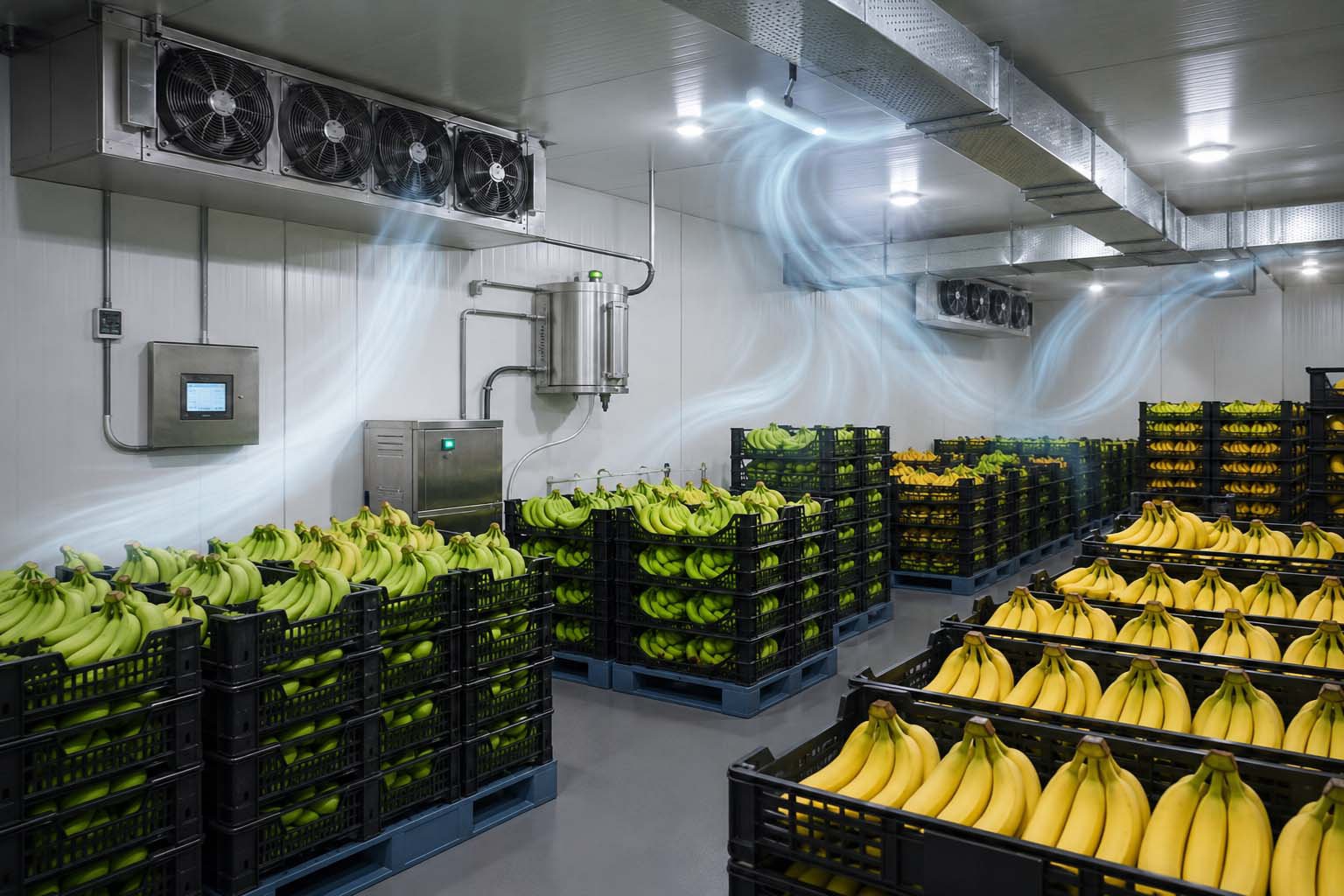
A modern fruit ripening chamber is designed to create a controlled environment where bananas ripen in a safer, cleaner, and more uniform way. It works as a specialized cold chain solution for banana traders, ripening operators, wholesalers, and fruit supply businesses.
For a basic understanding of how fruits naturally change color, texture, aroma, and maturity, readers can also refer to this external resource on the fruit ripening process.
The Problem: Uneven Banana Color and Ripening Issues
The business was facing repeated buyer complaints because the bananas were not ripening evenly. The fruit was loaded into the chamber in good physical condition, but after ripening, the batch showed different color stages.
Common Problems Found
- Some bananas remained green after the ripening cycle.
- Some bananas developed green tips and patchy yellow color.
- Few fruits became over-soft before the full batch was ready.
- Black spots appeared early on selected fruits.
- Fruit firmness was inconsistent across the batch.
- Sorting rejection and wastage increased.
- Retailers and wholesalers complained about poor visual quality.
In the banana market, appearance matters. Buyers usually judge quality by fruit color, firmness, freshness, and shelf life. If bananas look uneven, buyers may reject the stock or negotiate a lower price.
Important Finding: Uneven banana color is not always caused by poor fruit quality. In many cases, it happens because the ripening chamber is not operated with proper temperature, airflow, humidity, and ethylene control.
Root Cause Analysis
A detailed review of the ripening process showed that the chamber was being used, but the process was not fully controlled. The main issues were related to temperature variation, poor airflow, uneven ethylene distribution, improper humidity, wrong loading pattern, and lack of monitoring.
1. Incorrect Temperature Control
Temperature is one of the most important factors in banana ripening. If the temperature is too low, bananas ripen slowly and may remain green. If the temperature is too high, bananas ripen too fast, lose firmness, and may develop black spots.
2. Poor Air Circulation
Airflow must reach every box and pallet inside the ripening chamber. If banana crates are stacked too tightly or placed against the wall, airflow becomes blocked. This creates different ripening stages inside the same batch.
3. Uneven Ethylene Distribution
Ethylene is used to trigger the natural ripening process. However, if ethylene gas is not distributed evenly, some bananas ripen faster while others remain under-ripened. Proper airflow and ventilation are necessary for controlled ethylene movement.
4. Improper Humidity Management
Humidity helps protect banana skin quality. Low humidity can cause dull skin, dehydration, and weight loss. High humidity without proper ventilation can increase moisture-related problems.
5. Poor Loading Pattern
Loading pattern directly affects airflow, cooling, and ethylene circulation. A ripening chamber should not be treated like a normal storage room. Proper spacing is required around crates and pallets.
6. Lack of Monitoring
The ripening process was mainly managed through manual observation. Without temperature logging, humidity monitoring, and batch-wise records, it was difficult to understand why one batch performed well and another failed.
Problem vs Solution
| Problem Area |
Impact on Quality |
Corrective Action |
| Temperature fluctuation |
Green tips, soft fruit, uneven color |
Stable temperature control and monitoring |
| Blocked airflow |
Different ripening stages in one batch |
Correct crate spacing and airflow clearance |
| Uneven ethylene exposure |
Patchy color and under-ripening |
Controlled ethylene application and ventilation |
| Poor humidity control |
Dull skin, dehydration, poor appearance |
Humidity monitoring and balanced ventilation |
The Solution: Controlled Banana Ripening Chamber Management
To solve the issue, the business improved its banana ripening chamber operation with a more systematic process. The goal was to make the ripening cycle stable, repeatable, and quality-focused.
The improvement focused on temperature control, humidity monitoring, airflow correction, controlled ethylene application, loading pattern improvement, ventilation timing, and quality checking before dispatch.
Businesses planning to set up or upgrade a professional ripening facility can explore verified banana, mango and papaya ripening room suppliers on ColdRoomBazaar.com.
Key Improvements Made
- Temperature control was stabilized for better ripening consistency.
- Air circulation was improved around banana boxes and pallets.
- Ethylene application was standardized according to chamber load.
- Humidity levels were monitored more carefully.
- Box stacking and pallet placement were corrected.
- Ventilation timing was improved after ethylene exposure.
- Operators followed a clear ripening cycle process.
- Quality checking was introduced before dispatch.
Implementation Process
Step 1: Chamber Inspection
The banana ripening chamber was inspected to check insulation condition, door sealing, cooling performance, evaporator airflow, temperature control, and internal loading arrangement.
Step 2: Temperature and Humidity Monitoring
Temperature and humidity were monitored during the complete ripening cycle. Readings were checked at different chamber points to understand variation inside the room.
Step 3: Airflow Correction
Banana boxes were rearranged to maintain proper space for air movement. This helped distribute temperature and ethylene more evenly across the chamber.
Step 4: Ethylene Application Standardization
Ethylene exposure was managed based on fruit maturity, chamber capacity, load quantity, and required ripening stage. This helped avoid over-exposure in some areas and under-exposure in others.
Step 5: Ventilation and Holding
After ethylene exposure, ventilation was managed properly to remove excess gas and stabilize the chamber environment. The holding period was also monitored to avoid over-ripening before dispatch.
Step 6: Final Quality Check
Before dispatch, the team checked banana color, firmness, skin quality, and overall market readiness. This helped ensure that only better-quality bananas were supplied to buyers.
Results and Benefits
After improving the banana ripening chamber management process, the business achieved better control over final fruit quality. The bananas became more uniform in color, more consistent in firmness, and more acceptable in the market.
| Result Area |
Business Benefit |
| Uniform banana color |
Improved buyer confidence and better visual quality |
| Better ripening consistency |
More predictable dispatch planning |
| Reduced wastage |
Lower rejection due to patchy color, green tips, and soft fruit |
| Improved shelf life |
More time for transport, distribution, and retail sale |
| Higher market acceptance |
Better selling value and fewer buyer complaints |
1. More Uniform Banana Color
The most visible improvement was in fruit color. Bananas achieved a more even yellow shade across the batch. Green tips and patchy skin color were reduced.
2. Better Ripening Consistency
The ripening cycle became more predictable. Operators could plan dispatch more confidently because the batch result became more consistent from cycle to cycle.
3. Reduced Fruit Wastage
Earlier, some bananas were rejected due to under-ripening, over-ripening, black spots, or poor appearance. After process improvement, wastage reduced because more bananas reached market-ready quality.
4. Improved Shelf Life
Controlled ripening helped prevent early softening. This improved shelf life and gave traders more time for transport, distribution, and retail sale.
5. Better Buyer Confidence
Wholesalers and retailers prefer fruits that look uniform and fresh. Better color and firmness improved buyer confidence and reduced quality-related complaints.
Key Takeaways
- Uneven banana color is often caused by poor chamber control, not only fruit quality.
- Temperature, humidity, airflow, and ethylene must be managed together.
- Correct loading pattern is essential for uniform banana ripening.
- A banana ripening chamber needs SOP-based operation and regular monitoring.
- Controlled ripening helps reduce wastage and improve market quality.
- Better fruit appearance improves buyer trust and selling value.
- Cold chain businesses should focus on both equipment quality and operation quality.
Conclusion
This case study shows that a banana ripening chamber can solve uneven fruit color and improve ripening quality when it is operated with proper control. The chamber alone is not enough. The real result comes from correct temperature management, balanced airflow, controlled ethylene distribution, proper humidity, improved loading, and regular monitoring.
For banana traders, fruit wholesalers, cold storage operators, food processing businesses, and cold chain companies, professional ripening chamber management can reduce wastage, improve shelf life, increase buyer satisfaction, and support better market pricing.
In a competitive fruit market, quality is not optional. Uniform color, better firmness, and consistent ripening can directly improve business performance.
Call-To-Action
Planning to set up a banana ripening chamber or upgrade your existing fruit ripening facility?
ColdRoomBazaar.com helps buyers connect with cold chain suppliers, banana ripening chamber providers, cold room manufacturers, refrigeration contractors, PUF panel suppliers, and cold storage solution companies.
Explore verified banana, mango and papaya ripening room suppliers today and find the right solution provider for your project.
FAQ: Banana Ripening Chamber and Fruit Ripening Quality
1. Why do bananas ripen unevenly in a ripening chamber?
Bananas ripen unevenly when temperature, airflow, humidity, ethylene distribution, or loading pattern is not properly managed. If some boxes receive more air or gas than others, the final fruit color becomes inconsistent.
2. How does a banana ripening chamber improve fruit quality?
A banana ripening chamber improves fruit quality by controlling temperature, humidity, airflow, ventilation, and ethylene exposure. This helps bananas ripen more uniformly with better color, firmness, and shelf life.
3. What causes green tips in ripened bananas?
Green tips are commonly caused by low temperature, poor ethylene exposure, blocked airflow, immature fruit, or incomplete ripening cycle. Proper chamber management can reduce this issue.
4. Can a fruit ripening chamber reduce banana wastage?
Yes. A properly operated fruit ripening chamber can reduce wastage by preventing under-ripening, over-ripening, patchy color, early softening, and black spots. This improves market acceptance.
5. Who should use a commercial banana ripening chamber?
Banana traders, fruit wholesalers, cold storage owners, supermarkets, exporters, food processing units, and cold chain businesses can benefit from a commercial banana ripening chamber.

 06/06/2026, 1:15 pm


Comments 0