
 13/10/2026, 3:09 pm
Before anyone builds a cold storage facility, one question comes up more than any other: what Cold Room Temperature does this product actually need? Get it wrong, and the result may be spoiled stock, unnecessary electricity use or a refrigeration system working harder than required.
Cold Room Temperature is not one fixed number. It changes according to the product, variety, maturity, packaging and intended storage duration. This guide provides general reference ranges for common cold-chain categories and explains why temperature and humidity should always be considered together.
Key Point: Different products require different temperature and humidity conditions. A single cold room setting may not be suitable for every commodity.
Every perishable product responds differently to temperature. Fruits and vegetables remain biologically active after harvest, so cooling is used to slow respiration and deterioration. However, some tropical products can be damaged when stored at temperatures that are too low.
Dairy products, chilled meat and seafood require controlled refrigeration to maintain quality and safety. Frozen products need consistently low temperatures to remain fully frozen and reduce quality loss caused by thawing and refreezing.
This is why multi-commodity cold storage often requires separate chambers instead of one universal temperature setting.
| Product Category | Typical Storage Temperature (General Guide) |
Relative Humidity / Condition | Important Note |
|---|---|---|---|
| Temperate Fruits Apples, grapes and similar fruits |
0°C to 4°C | Generally 90–95% | Exact temperature depends on the fruit and variety. |
| Tropical Fruits Bananas, mangoes and similar fruits |
Generally 10°C to 15°C depending on product | Generally 85–95% | Many tropical fruits can suffer chilling injury at very low temperatures. Bananas are commonly stored around 13°C to 15°C. |
| Leafy Vegetables | Generally 0°C to 2°C | Typically 95–100% | Product-specific requirements apply. Some vegetables require warmer conditions. |
| Other Vegetables | Product-specific | Product-specific | Cucumbers, tomatoes, onions, potatoes and other vegetables have different storage requirements. |
| Dairy Products Milk and many chilled dairy products |
Generally 0°C to 4°C | Product-specific | Milk and many chilled dairy products are commonly stored at or below 4°C. Cheese, butter and other dairy products can require different conditions. |
| Ice Cream | -18°C or colder | Maintain stable frozen conditions | Commercial storage may use approximately -20°C to -25°C to help maintain product quality and texture. |
| Fish & Seafood – Fresh | 0°C to 2°C | High humidity; keep close to melting-ice temperature | Fresh seafood has a short storage life and should be chilled as quickly as possible. |
| Fish & Seafood – Frozen | -18°C or colder | Maintain stable frozen conditions | Avoid temperature fluctuation and partial thawing. |
| Meat – Fresh / Chilled | Generally 0°C to 4°C | Usually high relative humidity | For longer chilled storage, temperatures closer to 0°C are generally preferred. Exact conditions vary by meat type. |
| Meat – Frozen | -18°C or colder | Maintain stable frozen conditions | Colder storage can extend practical frozen-storage life for some products. |
| Frozen Food | -18°C or colder | Maintain stable frozen conditions | Minimise temperature fluctuations throughout storage and distribution. |
| Flowers | Species-specific | Generally high humidity | Many temperate cut flowers can be stored near 0°C to 4°C, while tropical flowers may require considerably warmer conditions. |
| Mushroom | 0°C to 1.5°C | 95–98% | Storage life is typically around 5–7 days at approximately 1.5°C under suitable conditions. |
| Pharmaceuticals / Vaccines | Product-specific | Follow manufacturer and regulatory requirements | Many refrigerated vaccines require 2°C to 8°C. Some frozen vaccines require much lower temperatures, while certain ultra-cold products require specialised storage. |
Important: These temperatures are general reference ranges, not universal design specifications. Exact storage temperature, relative humidity and storage duration depend on the specific commodity, variety, packaging, maturity, processing method and manufacturer or regulatory requirements. Always confirm product-specific storage conditions before designing or operating a cold room.
Fruit storage cannot be handled with one universal temperature. Temperate fruits such as apples and grapes can often be stored at temperatures close to 0°C, depending on variety and storage duration.
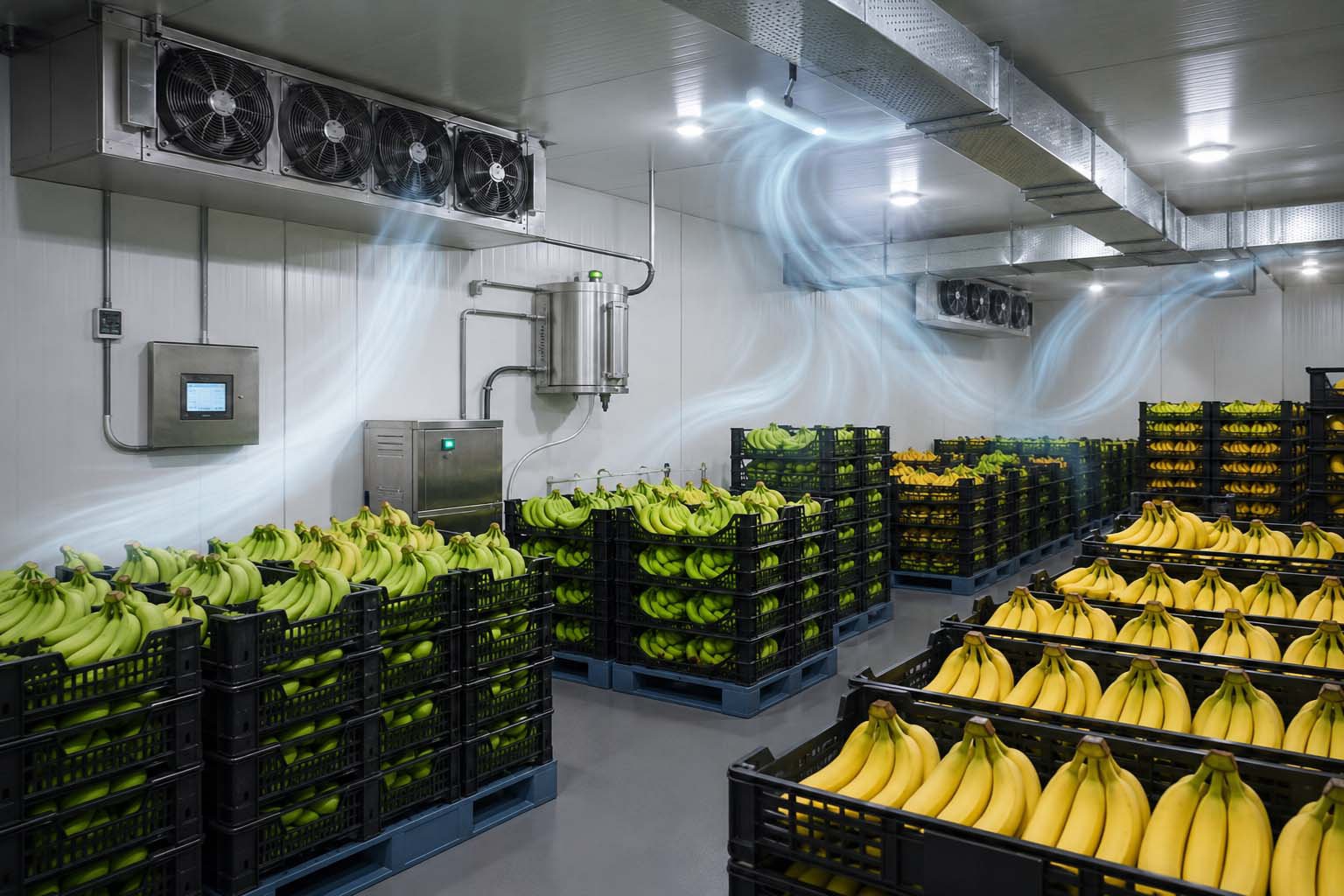
Tropical fruits such as bananas and mangoes are different. Many tropical fruits can suffer chilling injury if temperatures fall too low.
Example: Bananas generally require considerably warmer storage conditions than apples. Storing both products in the same cold room can therefore create quality problems.
Vegetables have a very wide range of storage requirements. Leafy vegetables generally require low temperatures and very high relative humidity to reduce wilting and moisture loss.
Other vegetables can require very different conditions. Potatoes, onions, tomatoes and cucumbers should not automatically be stored under the same temperature and humidity settings.
Therefore, cold room design should always begin with the exact vegetable or group of compatible vegetables being stored.
Milk and many chilled dairy products generally require refrigeration close to 0°C to 4°C. However, exact requirements vary according to the dairy product, packaging and processing method.
Temperature fluctuation is especially important. Frequent door openings, insufficient refrigeration capacity or poor insulation can cause the room temperature to rise repeatedly and increase the refrigeration workload.
Fresh fish and seafood require very rapid cooling and are generally maintained close to melting-ice temperature. A practical cold room reference range is approximately 0°C to 2°C.
Frozen seafood requires a completely different refrigeration system. It should generally be maintained at -18°C or colder throughout storage and distribution.
Important: Avoid repeated thawing and refreezing. Stable frozen conditions are important for both product quality and cold-chain reliability.
Fresh or chilled meat is generally stored between approximately 0°C and 4°C, depending on meat type and intended storage duration.
For frozen meat, -18°C or colder is commonly used as a general storage reference.
Cold-chain consistency is particularly important because partial thawing followed by refreezing can reduce product quality.
For many frozen food products, -18°C or colder is the common reference point for frozen storage.
Ice cream can require even colder commercial storage, often approximately -20°C to -25°C, because its texture is particularly sensitive to temperature fluctuations.
The objective is not only to reach the required temperature once, but to maintain it consistently throughout storage and distribution.
Flowers do not have one universal cold storage temperature. Many temperate cut flowers can be stored close to 0°C to 4°C, while tropical flowers may require significantly warmer conditions.
Fresh mushrooms require particularly cool and humid storage. A useful general reference is approximately 0°C to 1.5°C with 95–98% relative humidity.
Under suitable conditions, mushroom storage life is typically around 5–7 days at approximately 1.5°C.
There is no single Cold Room Temperature suitable for all pharmaceutical products. Storage conditions must follow the manufacturer's approved specifications and applicable regulatory requirements.
Many refrigerated vaccines require storage between 2°C and 8°C. However, some products require frozen or ultra-cold storage conditions.
Because pharmaceutical products can be sensitive to temperature excursions, these facilities normally require accurate monitoring, alarms and documented temperature records.
For pharmaceutical products: Never select storage temperature from a general cold room chart alone. Always follow the approved manufacturer and regulatory storage instructions.
Several common mistakes can create temperature instability and product losses even when the refrigeration equipment is working.
Choosing the correct Cold Room Temperature is not simply a matter of setting a thermostat. Temperature affects insulation requirements, refrigeration capacity, compressor sizing, evaporator selection, humidity control and room layout.
For this reason, cold room design should start with the product requirement rather than selecting equipment first.
Before planning a cold room, define: product type, target temperature, relative humidity, daily loading quantity, incoming product temperature, storage duration, door-opening frequency and room dimensions.
Refrigeration capacity should also be matched correctly to the required heat load. Buyers can explore relevant Compressors & Condensing Units for commercial cold room applications.
If you are planning a completely new facility, you can also explore Turnkey Cold Storage Projects to connect with relevant project solution providers.
Planning a commercial cold room for fruits, vegetables, dairy, seafood, frozen food or another temperature-sensitive product? Connect with relevant cold-chain businesses through Cold Room Bazaar.
Visit ColdRoomBazaar.com Call +91 786-0000-472Interactive Actions




Comments 0